
In my teaching of history, I aim both to strengthen students’ ability to think historically and to expose them to history as a discipline. By being transparent about the work that historians do and unmasking the processes by which historians make sense of and give meaning to the past, I try to help students understand history not as a collection of facts or a simple chronicle but as a way of thinking about and understanding their own and other societies and cultures, past and present – to understand both broader historical developments and individuals’ actions and experiences. In recent years, I have turned to public and digital history as pedagogical approaches for educating students as active practitioners of history, rather than merely as passive recipients of information. In addition to writing research papers, students have worked on exhibitions, websites, timelines, storymaps, avatar projects, unessays, and community engagement projects.
Publications & Talks Related to Teaching
“Learning to Take Chances: Ungrading, Experimentation, and Cura Personalis in History Courses,” in Effective Alternative Assessment Practices in Higher Education, edited by Antione Tomlin and Christine Nowik, forthcoming with Information Age Publishing.
“Finding Germany in the Neighborhood,” German Studies Collaboratory Zeitnah Blog, 7 March 2023.
With Nicole Coleman, Phil Keisman, Janice McGregor, and Eli Rubin, “Escape from Grading Hell: How to Move Away from Grades and Focus on Learning,” German Studies Collaboratory Zeitnah Blog, 21 February 2023.
With Amy Woodson-Boulton, “Teaching Modern World History, Or: How We Learned to Stop Worrying and Embrace the Urgency of Climate Change,” in World History Connected: The eJournal of Learning and Teaching, Vol. 18, No. 2 (June/July 2021), https://worldhistoryconnected.press.uillinois.edu/18.2/pdfs/04_WHC_18_2_Drummond.pdf.
“How I Hacked My Syllabus: Experiments in Teaching,” German Studies Collaboratory Zeitnah Blog, 19 July 2021.
“Rethinking History Pedagogy and Teaching with the Shift Online,” LMU This Week, 12 October 2020.
“Free History,” Playa Vista Direct, 12 February 2019
Courses
The below list of courses focuses on those courses that I have taught since the latest rounds of curricular reforms or are currently in development.
First-Year Seminars (University Core Curriculum)
First-Year Seminars are designed to introduce students to doing college-level intellectual work and to develop reading, writing, speaking, research, analytical, and critical thinking skills through the study of a particular topic. FYS courses have a particular focus on writing – not just in terms of basic mechanics of writing but also as a way of thinking and communicating and as a process that includes drafting and revision.
FFYS 1000 Bystanders during the Holocaust
This FFYS examines the variety of responses to the Nazi persecution of Jews and others. The most vexing questions that students confront in the study of the Holocaust are why so few people acted to help victims or to resist Nazi policies and what distinguished those people who did act from those who did not. This course will draw on studies of bystanders from historians, philosophers, theologians, sociologists, and psychologists as well as two specific case studies, of Jedwabne in Poland and of Le Chambon sur Lignon in France, to examine the range of bystander responses – from complicity, to apathy, to rescue and resistance. Through an intensive study of bystanders, students will engage important historical and ethical questions about individual agency – why some people chose to collaborate with the Nazis, others to remain passive, and others to resist – and about how the Holocaust happened.
FFYS 1000 The Global Great War
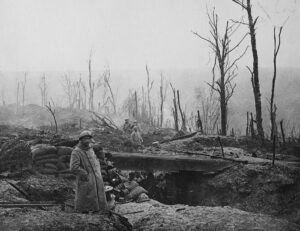
This FFYS explores the causes and consequences of a war that radically transformed the war and shaped the history of the twentieth century – not just in Europe, but also in Africa, India, and Asia. We consider war strategies and technologies, life in the trenches, mass casualties and the development of new ideas about war wounds and disabilities, the mobilization of the home front (including women and children), and the development of war cultures, as well as the rituals of commemoration and the revolutionary developments that emerged out of the war. Using a variety of primary and secondary sources, we study the lived experiences of the war, on the frontlines and the home front, of both Europeans and peoples from the colonies – and we will seek to reconstruct the everyday lives of soldiers, women, medics, artists, captives, conscientious objectors, and peace activists through the avatar project. Digital version of the fall 2023 syllabus.
FFYS 1000 A History of Now (in development)
Historical Analysis and Perspectives Courses (University Core Curriculum)
HIST 1050 Modern World History

HIST 1060 Modern Global Environmental History
This world history course has a particular focus on environmental history: how humans, animals, natural forces, and science and technology have shaped the environment; how historical developments such as migration, empire, trade, industrialization, and urbanization have affected humans’ relationships with nature; and how the environment has affected historical developments.
HIST 1203 Religion, Society, and the Search for Meaning in Modern Europe
HIST 1204 Revolutions in the Making of Modern Europe
HIST 1250 Black Europe (in development)
History 2000-level Seminar

HIST 2910 Telling History in Public
This lower-division seminar course introduces students to the study of history, including historical method, the writing of history, and historical interpretation, with a particular focus on the field of public history. We explore the various ways that we think about, interpret, remember, and represent the past, including in documentary and feature films, in popular histories, in historical fiction, in graphic novels, in museums, through monuments and memorials, through heritage tourism, through websites, and so on. In doing so, we engage questions about the intersections of history, memory, and identity — about how representations of the past inform our understandings of contemporary issues and public policy. Class projects have included the writing of historical landmark nominations, “free history lessons” in the community, website projects, exhibitions, and oral histories. In fall 2019, students curated an exhibition about Loyola Marymount University’s history, which was on display in the William H. Hannon Library during the spring 2020 semester (until COVID closed campus) and also included a companion website with a digital version of the exhibition. In fall 2020, the focus was on the history of policing, prisons, and mass incarceration, in conjunction with the 2020-2021 Bellarmine Forum, with students conducting oral history projects with people involved with Loyola Law School‘s Project for the Innocent. Digital version of the fall 2020 syllabus. This course carries an Engaged Learning flag for the Core.
Interdisciplinary Connections Courses (University Core Curriculum)
HIST 3210 Other Europes
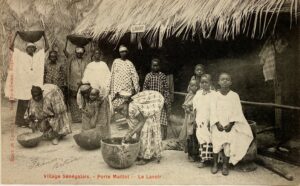
The discipline of history has long been intertwined with European nation- and empire-building projects, resting on an assumption that Europe is a white and Christian space. How does our understanding of European history change if we center the experiences of people often relegated to the margins? What “other Europes” are there? Other Europes centers the experiences of often marginalized groups in European history, marginalized both in history itself and in many history courses. Employing an interdisciplinary, transnational,
and intersectional analytical framework to “flip the script” on European history, we will look at race to examine the experiences of people of African, Asian, and Middle Eastern descent in Europe, both migrants and their European-born descendants; at religion to examine the experiences of Jews, Muslims, and other non-Christians; at gender and sexuality to examine the experiences of queer and trans Europeans, as well as of women and men who did not conform to gender ideals; at disability to examine the experiences of the disabled and those deemed medically “abnormal”; and at frontiers to look at European history from its geographical frontiers, both from the colonies and from the borderlands and peripheries of Europe. Digital version of the spring 2023 syllabus.

HIST 3272 Culture & Politics of Weimar Germany
Weimar Germany (1919-1933) is often recalled as a failed experiment in democracy, which paved the way – seemingly inevitable – for the rise of the Nazi party. But Weimar was more than just a pre-history of the Third Reich, more than just a short-lived political and social experiment wracked by instability and discontent. It was at the same time a center of considerable cultural innovation and creative ferment – in literature, painting and sculpture, architecture, film, and popular theater. This Interdisciplinary Connections course will examine the intersections of cultural and politics in Weimar Germany, both the ways in which art and culture spoke to the political and social questions of the day and the ways in which art and culture themselves became politicized. We will discuss the legacies of World War I for Weimar, Weimar’s troubled beginnings and period of stability, Weimar culture in a variety of forms, and lived experiences of various groups of Germans, including workers, women, gays and lesbians, Black Germans, German Jews, and more. We’ll end the semester with a discussion of Weimar’s demise, its legacies, and popular representations of the period. Digital version of the spring 2021 syllabus.
Upper-Division History Courses
HIST 4215 European Imperialism

HIST 4273 Nazi Germany
Nazism and the Holocaust have cast a long shadow over German history, both coloring our understanding of German history before 1933 and shaping the political, social, and cultural developments in Germany (and the two Germanies) since 1945. In this course, we will examine the significance of the Nazi era in modern German history. We will explore the origins of National Socialism, the Nazi rise to power in the context of the Weimar Republic, National Socialist ideology, the relationships between state and party and between state and society, the nature of everyday life in Nazi Germany, the experiences of a variety of different groups under Nazi rule, the persecution of Jews and other minorities, the use of terror, and the dynamics of war and genocide. In addition, we will examine how Germans themselves have grappled with the history of Nazi Germany — a process known as Vergangenheitsbewältigung, the working through and coming to terms with the past — by analyzing how Germans have dealt with the public history and memorialization of the Nazi era through the site visits done as part of the global immersion trip to Berlin over Spring Break. In spring 2019, students completed a class timeline project using primary sources from German History in Documents and Images, the German Propaganda Archive, and other digital repositories, which was published in the inaugural issue of the Central Europe Yearbook. This course carries an Engaged Learning flag for the Core.

By Steffen Rehm, own work, Public Domain,
https://commons.wikimedia.org/w/index.php?curid=1425035
HIST 4910 Topics in Public History: Divided Germany in Cold War Europe
In 1945, Germany was in ruins. World War II had destroyed Germany’s infrastructure; the defeat of the Nazis had morally delegitimized Germany’s institutions; and the occupying powers had divided Germany’s diminished territory into a capitalist West and a socialist East. The Federal Republic of Germany (West Germany) and the German Democratic Republic (East Germany) represented two different experiments in how to rebuild a society after such devastation, even as they remained more closely intertwined than either side cared to admit. This course examines the history of these two states and the solutions they developed to common challenges, including denazification, the territorial division of the country, the formation of new national identities, economic reconstruction, migration, social and cultural change, and unification in 1989/1990, as well as questions of memory and public history, both how the Federal Republic of Germany and the German Democratic Republic dealt with the Nazi past and the memory of divided Germany and the Cold War in post-unification Germany. Students completed individual avatar projects and group podcasting projects, which were brought together in a storymap. This course carries an Engaged Learning flags for the Core.
HIST 4910 Topics in Public History: War, Memory, and Identity (Croatia study abroad; in development)
HIST 4910 Topics in Public History: Empire, Migration, and Reparations (in development)
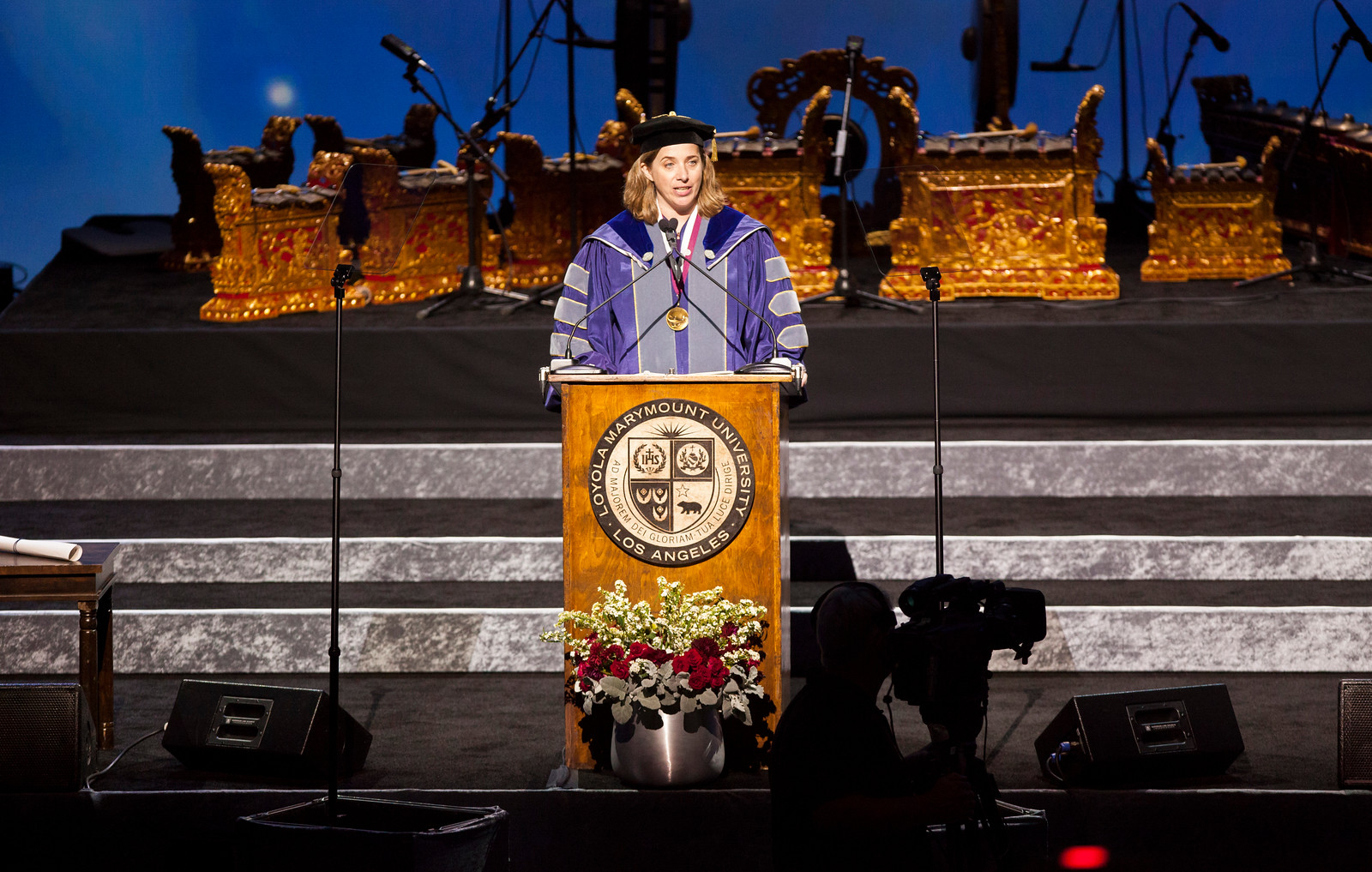
Featured image: speaking at the inauguration of Timothy Law Snyder, LMU’s 16th president, October 2015 (photo credit: Aaron Dominguez)
